Control the axis of the phase diagrams (see below for parameter definition):
To keep the visualization light, we "sparsified" the raw output with .sparsify.py#L5-L9. That is, we throw away points where the absolute difference between two time steps is greater than 0.00001. This lead to premature termination of runs and more rough results. That said, the results are qualitatively the same than with raw data. If you want to run the app with raw data, follow the following instructions.
Individuals have opinions about how their institution manages their public goods. For illustration's sake, we assume that the abstract potential dependency on the current state on the group now takes the form of allocating resources to scale up institutions. The first set of transition rates
where i is the number of cooperators, n is group size, ϕ represents the influence of other groups on individual activation. And that
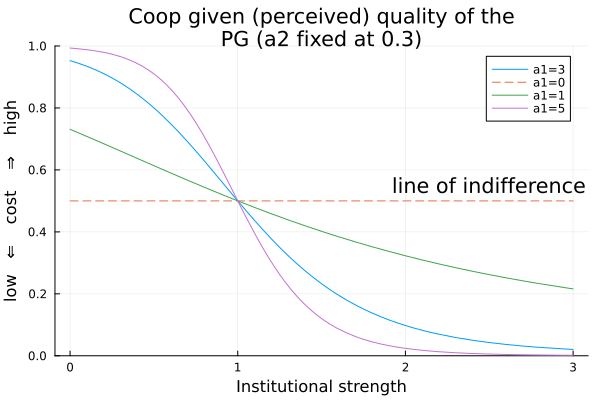
The function captures individual incentives to cooperate as the sigmoid function, where it is assumed that stronger institutions reduce the cost of cooperation. The function models the perceived quality of the public good as a function of the institutional level. The overall dynamics allows us to explore how cooperation depends on the perceived quality of the public good as a function of institutional strength. Concretely, we have
For a given set of params, function looks like:
Also, we assume that the functions respect
That is, and indicate individual indifference with respect to group strategy. The second set of transition rates includes resource requirement to upgrade institution, which here we assume to also take a sigmoid form:
The fitness function take the form
note that (fitness function) and (cost-benefits for groups) are taken to be equal to function (they share the same properties).
In the previous model, we explored how the copying rate of institutions, , was able to separate the timescale of information and contagion. Here, we are interested in how playing with the of means that groups change their institutions more independently and less because of imitating others. By look at the /, we can have a better idea of how the ratio of endogenous institutional influence to exogeneous on the group influence cooperation.